
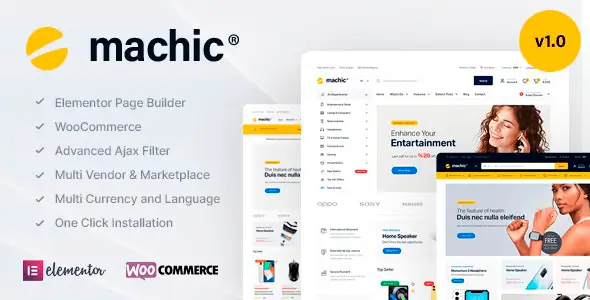
State: Product Activated


Official Version
Official version provided by the developers. Licensed under the GNU GPL, allowing use on an unlimited number of sites.
Technical Support
Professional assistance with any technical issues. Support is included in the price. Read our Support Policy.
Guarantees and Safety
100% safe and fully functional product. Completely risk‑free. 14‑day money‑back guarantee. Read our Refund Policy.
I use themes like Machic on stores that need the classic electronics layout: category-heavy homepage, promo banners, product grids, deal blocks, brand sections, and a mobile menu that pushes shoppers into taxonomy pages fast. It fits electronics, gadgets, accessories, parts, and marketplaces with a lot of SKU browsing. It is less pleasant when the project needs a very custom storefront architecture, because these themes are usually built around their own demo templates, Elementor widgets, WooCommerce hooks, and theme options rather than around a clean “build everything from scratch” approach.
What it solves well is speed of launching a store layout that already looks like an electronics niche shop. What it does not solve automatically is performance, filtering logic, or compatibility with every optimization layer. On these installs I usually spend more time removing overlap between the theme, Elementor, wishlist/compare/quick-view addons, and optimization plugins than on basic visual setup.
Machic is a theme, so the main frontend structure comes from theme PHP templates, WooCommerce template overrides, Customizer/theme panel settings, and page-builder content used on demo pages. In practice, the store archive, header, mobile menu, product cards, AJAX search, wishlist/compare buttons, quick view, and promo blocks are usually split between:
That distinction matters when you edit it:
Where templates usually live:
woocommerce/ folder for WooCommerce template overridesSettings are usually split in an annoying but normal way:
Assets are usually enqueued by the theme plus its companion plugins. On sites like this I always check DevTools → Network for:
jquery, jquery-corewc-add-to-cart, wc-cart-fragments, wc-add-to-cart-variationIf optimization breaks the UI, it is usually one of those handles or bundled files getting delayed/minified in the wrong order.
This is the most common failure. The theme depends on a chain of frontend scripts, and “optimize everything” settings often break execution order.
Typical symptom:
Root cause:
Fastest fix:
jqueryjquery-corewc-add-to-cart-variation$ is not defined, jQuery is not defined, or errors tied to variation/quick view files.If the product page variation selector is broken specifically, start with excluding wc-add-to-cart-variation from delay/defer and stop delaying jquery-core.
With themes in this category, demo import is rarely just “theme installed = site ready.” Menus, homepage assignment, widgets, Elementor settings, and required plugins often need manual cleanup.
Typical root cause:
Fastest fix:
On electronics stores, this happens when there are too many products, too many attributes, poor hosting, or a search addon querying too broadly.
Root cause:
WP_Query / taxonomy joinsFastest fix:
If the search endpoint itself is consistently slow, the issue is usually query cost, not CSS/JS.
This is normal for Woo themes that override WooCommerce templates. After WooCommerce updates, the theme may still be using older template versions.
Fastest fix:
I don’t edit the parent theme’s WooCommerce template files directly. The next theme update will wipe them.
All products we provide come only from official sources and verified developers. To confirm their integrity and safety, the archive has been scanned for viruses and malware. You can review the scan results at any time by clicking the button below.
View in VirusTotalMachic is a premium theme. In normal licensed use, it installs and runs as a theme, but purchase verification/activation is typically what unlocks the smooth update path, official support, and sometimes bundled premium plugin access or demo/import-related convenience.
Plain language:
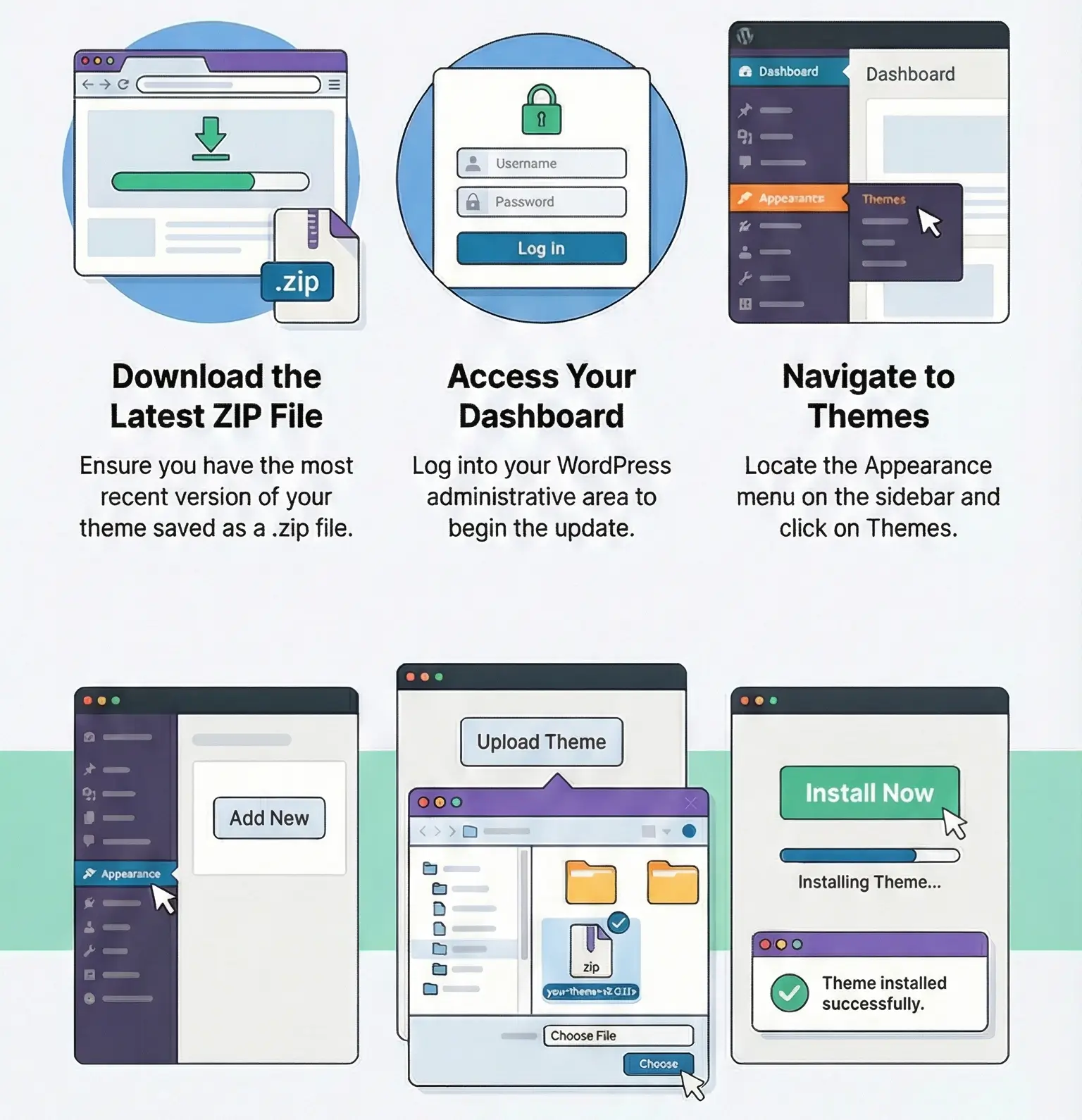
Manual update path:
That overwrite warning is the big one with a theme like this. If you edited:
header.phpthose changes are gone on update. I keep all modifications in a child theme and use Customizer/Elementor/theme options only for settings-level work.
Download Machic archive with the latest update and install it over the existing version. If there is no previous version installed, the theme can be installed using the standard method. You can find detailed instructions on how to update a theme or plugin on this page.
Yes, but most of its value is in the imported structure. Without demo content, you will build menus, homepage sections, widgets, and shop layout manually.
Because delayed/minified JS often disrupts the theme’s menu, filter, quick-view, or variation scripts. Exclude jquery-core, Woo variation JS, and the theme’s main JS first.
Yes, but do it in a child theme. Parent theme template edits will be overwritten on update.
Usually because menus, homepage assignment, widgets, required plugins, Woo pages, or Elementor CSS regeneration still need manual setup.
You can use any product from our store on as many websites as you like.
After purchasing a product, you’ll be able to download it — including the most recent version — for the next 72 hours. Once that period ends, you can either repurchase the product or switch to one of our membership plans.
With an active membership, updates are always included. You’ll have continuous access to the latest versions for as long as your membership remains active, without worrying about expiration dates.
Yes, we do. In most cases, you can expect a reply within 24–72 business hours. For simpler issues, we’re often able to respond much sooner.
You can contact us via live chat or open a support ticket directly from the product page — whichever is more convenient for you.
No, there are no limits. We don’t believe in restricting downloads. If you need to download a product multiple times, that’s absolutely fine.
We use professional, high‑performance storage systems to ensure downloads are fast, stable, and hassle‑free.
No, license keys are not included. In the past, license sharing and related issues caused account problems, so we decided to stop distributing keys.
That said, all products you receive are fully authentic. For items that normally require activation, we provide them pre‑activated, allowing you to install and use them immediately without dealing with license input or activation errors.
Yes — 100%. All products are original and distributed under the GNU GPL v2/v3 license.
The main difference compared to purchasing directly from the original author is that we don’t offer additional services such as custom development or one‑on‑one support. License keys are also not included. Instead, products that typically require activation are delivered ready to use, allowing installation on unlimited websites.
Yes, we stand behind our products. If you encounter an issue that cannot be resolved or a technical problem without a workable solution, we’ll do our best to help — and if necessary, issue a full refund.
Please note that refunds are not available if the product works as described but simply does not meet personal expectations. We’ve also encountered cases where refund requests were made while the product was still in use, which we cannot allow.
Our approach is simple: fairness and transparency. If you ever have a concern, just reach out — we’re always open to finding a reasonable solution that works for both sides.




Reviews
There are no reviews yet.