

State: Product Activated


Official Version
Official version provided by the developers. Licensed under the GNU GPL, allowing use on an unlimited number of sites.
Technical Support
Professional assistance with any technical issues. Support is included in the price. Read our Support Policy.
Guarantees and Safety
100% safe and fully functional product. Completely risk‑free. 14‑day money‑back guarantee. Read our Refund Policy.
I use AI Hub for product marketing sites, AI tool directories, startup landing pages, app showcases, and agency-style builds where the main job is presenting features, pricing, integrations, blog content, and lead capture. It’s the kind of theme I pick when the client wants a modern “AI/tech” look quickly and is fine staying inside the visual system the theme already ships with.
I don’t use it for projects that sound like “startup website” but are actually custom platforms: member dashboards, complex app onboarding, gated user flows, or database-heavy directories with custom filtering logic. The theme can present those products well, but it doesn’t replace application structure. Once the business logic moves beyond pages, posts, forms, and maybe WooCommerce, I stop relying on the theme to carry the project.
Most of the day-to-day work with AI Hub is done in the theme options panel, Customizer-style controls, and the bundled page builder stack. Homepage sections, headers, colors, fonts, spacing, section order, blog presentation, and marketing blocks are usually stored in the database as theme settings or page-builder data. That means non-developers can change a lot without touching code.
What is not truly visual-editor territory is the final PHP structure for archive templates, single post output, header logic, and any custom integration points the theme author hardcoded. If I need to alter markup, conditional rendering, or inject custom hooks in reliable places, I do it in a child theme. Parent theme edits are not safe; the next update replaces them.
This type of startup theme usually ships with a lot of front-end assets:
So the theme itself often “works” until optimization plugins get too aggressive. The most common real-world failures I see are:
When that happens, I don’t guess. I open DevTools → Console and Network. I’m checking for:
jQuery is not definedThe fastest fix is usually inside the cache/performance plugin:
jquery, jquery-core, jquery-migrate, and the theme’s main/frontend builder JS from delayThat is usually a missing required plugin or a partial import. The pages may import, but the header/footer builder, widgets, global theme options, or homepage assignment do not.
Fast fix:
If the import hangs or only brings in text without media, I also check PHP limits on the host:
memory_limitmax_execution_timeupload_max_filesizepost_max_sizeThis is the most common issue. Startup themes depend on front-end timing more than plain blog themes do.
Fast fix:
jquery-core.In Console, I usually see missing dependency errors or inline init functions firing before the relevant library loads.
The page may load, but icons render as empty squares or fallback fonts. That’s almost always a font URL or CORS problem, not a theme design issue.
Fast fix:
.woff, .woff2, .ttf requests returning 403/404.That is usually a plugin or SMTP issue, not an AI Hub theme issue. The theme styles the form; it doesn’t guarantee delivery.
Fast fix:
AI Hub will usually run without a license key after installation, so the theme can be activated and used. Without activation, what you generally lose is:
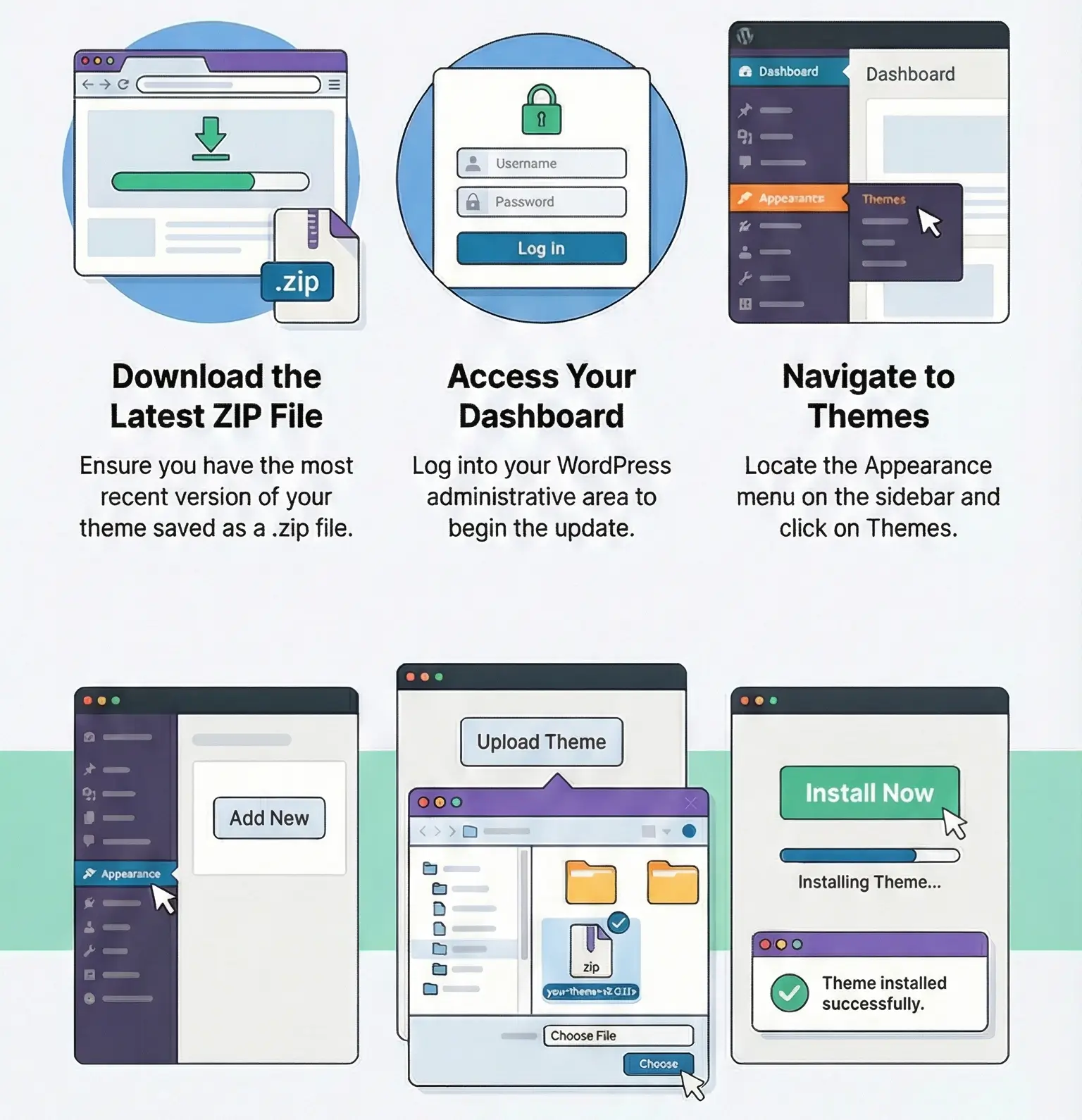
Manual updates are the fallback: upload the new theme ZIP via Appearance → Themes or replace the parent theme over FTP/SFTP. The real risk is not the update method; it’s custom work inside the parent theme. If you edited parent files, those edits are overwritten. I avoid that by using a child theme for PHP template changes and custom functions from the beginning.
If the theme depends on a bundled page builder or companion plugin, I also verify those versions separately. A parent theme update alone does not always update everything the layout depends on.
Download AI Hub archive with the latest update and install it over the existing version. If there is no previous version installed, the theme can be installed using the standard method. You can find detailed instructions on how to update a theme or plugin on this page.
All products we provide come only from official sources and verified developers. To confirm their integrity and safety, the archive has been scanned for viruses and malware. You can review the scan results at any time by clicking the button on the right. This gives you an extra level of confidence before downloading and using the files.
It’s good for the marketing site around the app. It’s not the backend product architecture.
Because script delay changed load order. Exclude jquery-core and the theme’s frontend JS bundle from delay/defer.
Usually yes, through the theme options and page builder. Structural PHP markup changes still belong in a child theme.
Most often: required plugins missing, import timeout, or homepage/menu/global settings not assigned after import.
You can use any product from our store on as many websites as you like.
After purchasing a product, you’ll be able to download it — including the most recent version — for the next 72 hours. Once that period ends, you can either repurchase the product or switch to one of our membership plans.
With an active membership, updates are always included. You’ll have continuous access to the latest versions for as long as your membership remains active, without worrying about expiration dates.
Yes, we do. In most cases, you can expect a reply within 24–72 business hours. For simpler issues, we’re often able to respond much sooner.
You can contact us via live chat or open a support ticket directly from the product page — whichever is more convenient for you.
No, there are no limits. We don’t believe in restricting downloads. If you need to download a product multiple times, that’s absolutely fine.
We use professional, high‑performance storage systems to ensure downloads are fast, stable, and hassle‑free.
No, license keys are not included. In the past, license sharing and related issues caused account problems, so we decided to stop distributing keys.
That said, all products you receive are fully authentic. For items that normally require activation, we provide them pre‑activated, allowing you to install and use them immediately without dealing with license input or activation errors.
Yes — 100%. All products are original and distributed under the GNU GPL v2/v3 license.
The main difference compared to purchasing directly from the original author is that we don’t offer additional services such as custom development or one‑on‑one support. License keys are also not included. Instead, products that typically require activation are delivered ready to use, allowing installation on unlimited websites.
Yes, we stand behind our products. If you encounter an issue that cannot be resolved or a technical problem without a workable solution, we’ll do our best to help — and if necessary, issue a full refund.
Please note that refunds are not available if the product works as described but simply does not meet personal expectations. We’ve also encountered cases where refund requests were made while the product was still in use, which we cannot allow.
Our approach is simple: fairness and transparency. If you ever have a concern, just reach out — we’re always open to finding a reasonable solution that works for both sides.



Reviews
There are no reviews yet.